
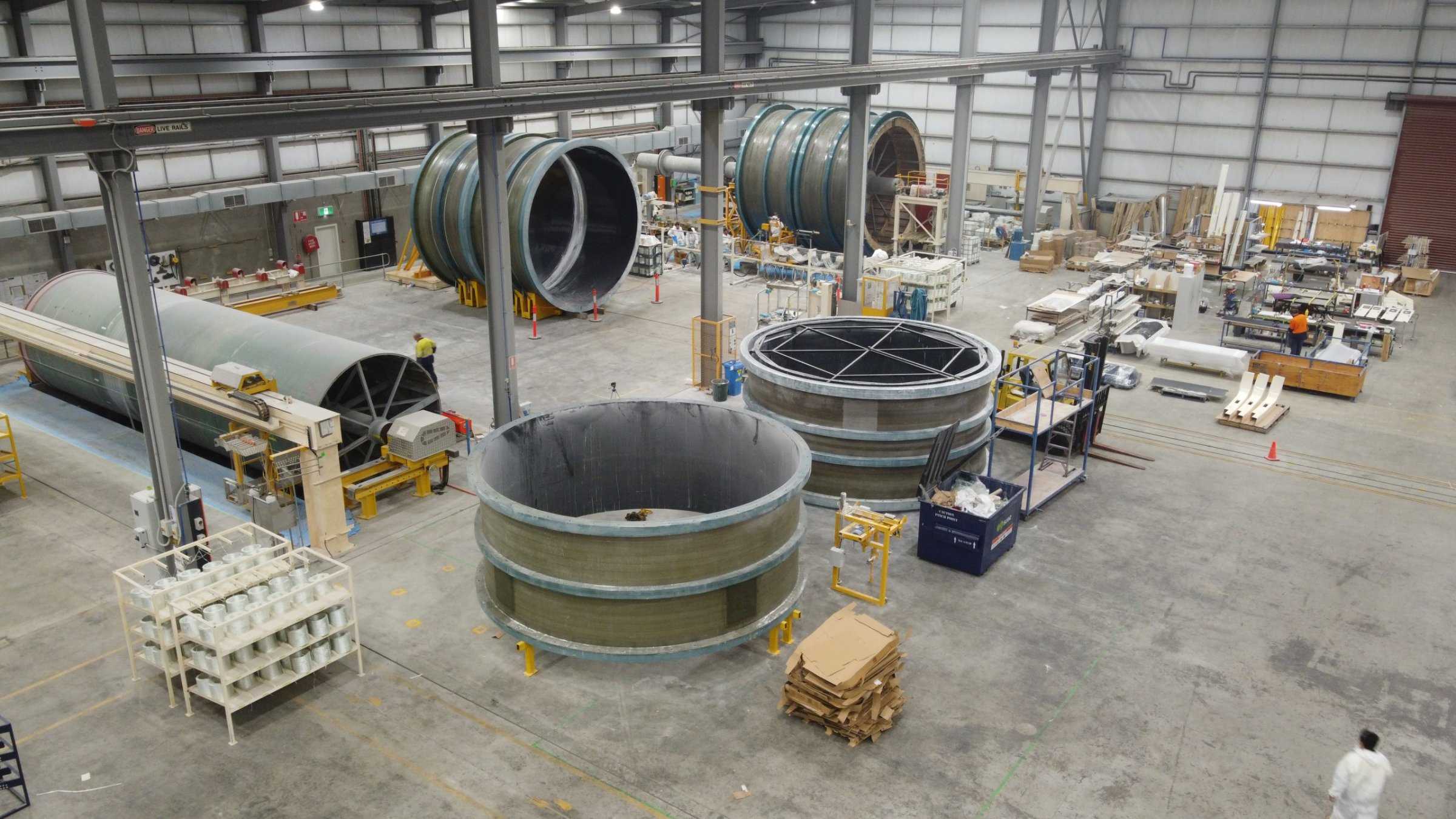
Capabilities
Composites: Why & How
Lighter, stronger for their weight, and built to outlast steel and concrete in harsh environments.
What is a composite?
A composite is an engineered product where you combine various materials to produce a material with specific performance characteristics. RPC produces FRP (fibre reinforced plastic), which uses different fibres bound in a thermosetting plastic — most commonly GRP (glass reinforced plastic, also known as fibreglass), which uses glass fibre bound by a polyester or vinyl ester resin. GRE is like GRP but uses epoxy resins to bind the fibres, and other materials use more exotic fibres such as carbon fibre and Kevlar.
- FibreGlass · Carbon · Kevlar
- ResinPolyester · Vinyl ester · Epoxy
- CompositeGRP · GRE · CFRP
Glossary
- FRP
- Fibre Reinforced Polymer/Plastic — fibres bound in a thermosetting resin.
- GRP
- Glass Reinforced Polymer/Plastic (“fibreglass”) — glass fibre with polyester or vinyl ester resin; RPC's most common material.
- GRE
- Glass Reinforced Epoxy — glass fibre with epoxy resin; used for high-pressure pipe.
- Carbon fibre
- Very high strength-to-weight ratio, high stiffness and low thermal expansion; used for lightweight products such as LWMVD.
- Kevlar (aramid)
- Flexibility where required and ballistic capability.
- Resin systems
- Polyester, vinyl ester, epoxy, fire-retardant and recyclable options.
Benefits
Why composites
Eight reasons asset owners and engineers choose composites.
Corrosion & chemical resistance
Resists acids, alkalis, solvents, corrosive fumes and harsh weather — it won't rust.
Strength without the weight
High strength at a lower weight than many traditional materials, so it is easier to transport, lift and install.
Long asset life
Designed for asset lives of 50 to 100+ years, depending on the product and application.
Low maintenance
No cathodic protection, painting cycles or rust treatment — virtually maintenance free once installed.
Fatigue resistance
Performs under repeated loading over decades.
Fire performance
Fire-retardant resin systems are available, including FRAS-compliant mine ducting and rail components tested to EN45545.
Electrical insulation
Non-conductive materials that do not conduct electricity or lightning.
Design freedom
Complex, integrated shapes moulded as one piece — including very large parts that are hard to make in metal.
Proven at scale
- 7.5m
GRP shafts up to 7.5m in diameter and more than 75m deep — the largest and deepest GRP shafts ever produced.
Central Interceptor - 45 years
GRP tanks built by Transfield RPC, inspected and cleared for continued service with more than 6 years' estimated remaining life.
Asset inspections case study - 150,000+
Rail seats designed and supplied.
Rail seating
Supporting the full lifecycle of composites
One team stays with your asset from first design to inspection and maintenance in service.
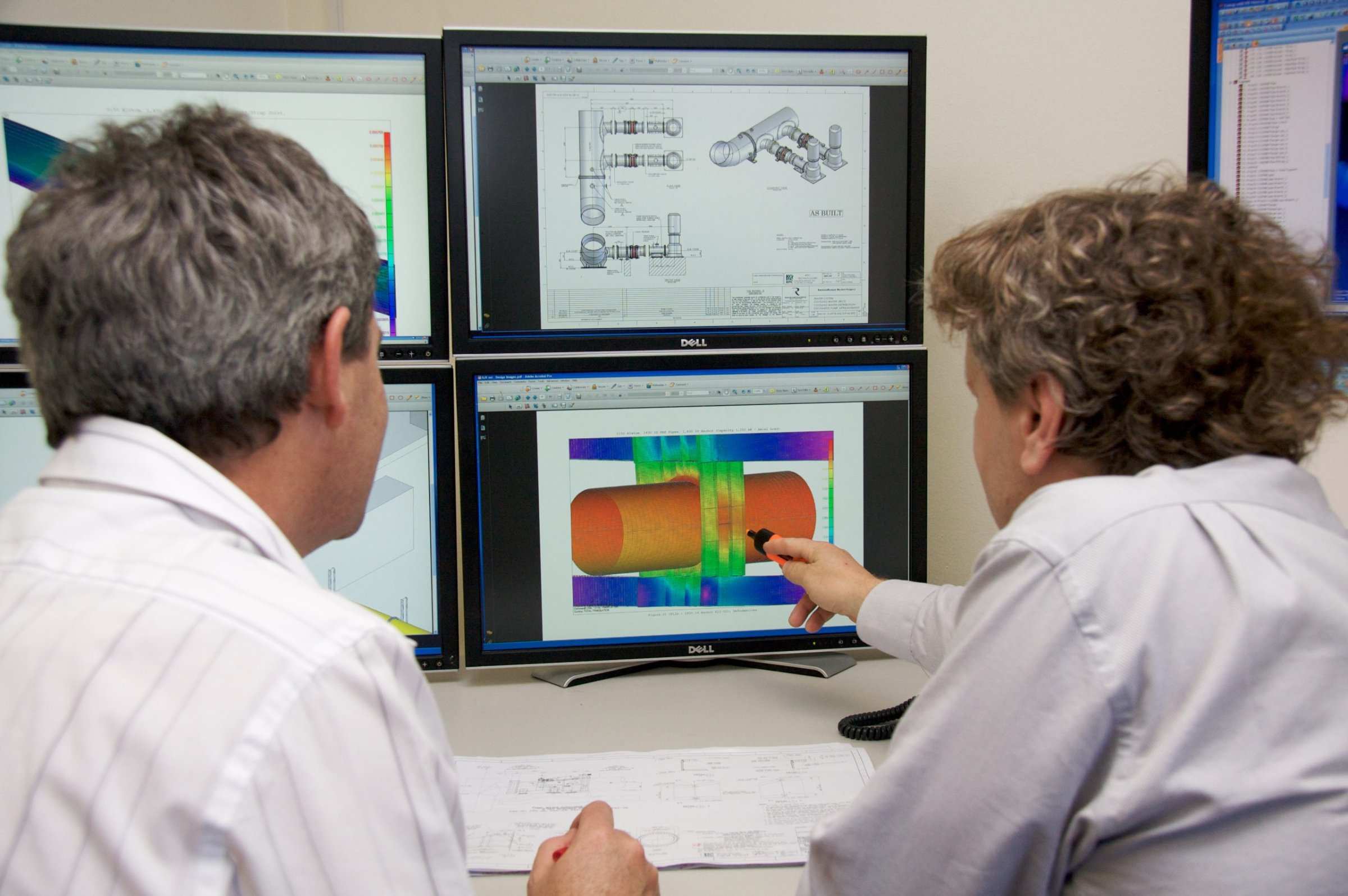
Design / Engineering
Concept and design, prototypes, materials engineering, CAD, 3D, FEA and Caesar Stress Analysis. Around 30% of our workforce hold engineering degrees.
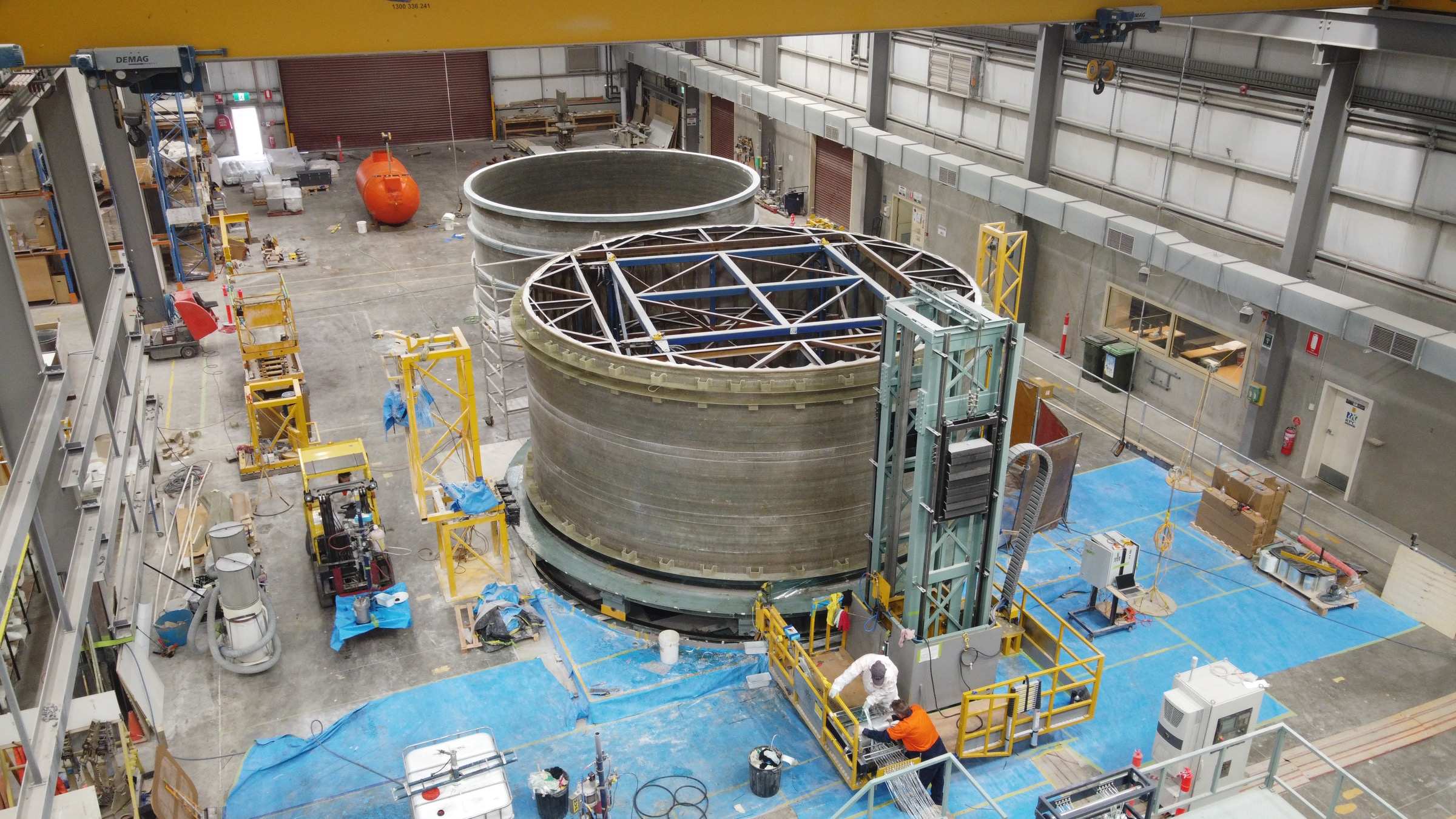
Manufacturing
Filament winding, infusion, prepreg moulding, hand lamination and specialty metal fabrication across five manufacturing facilities.
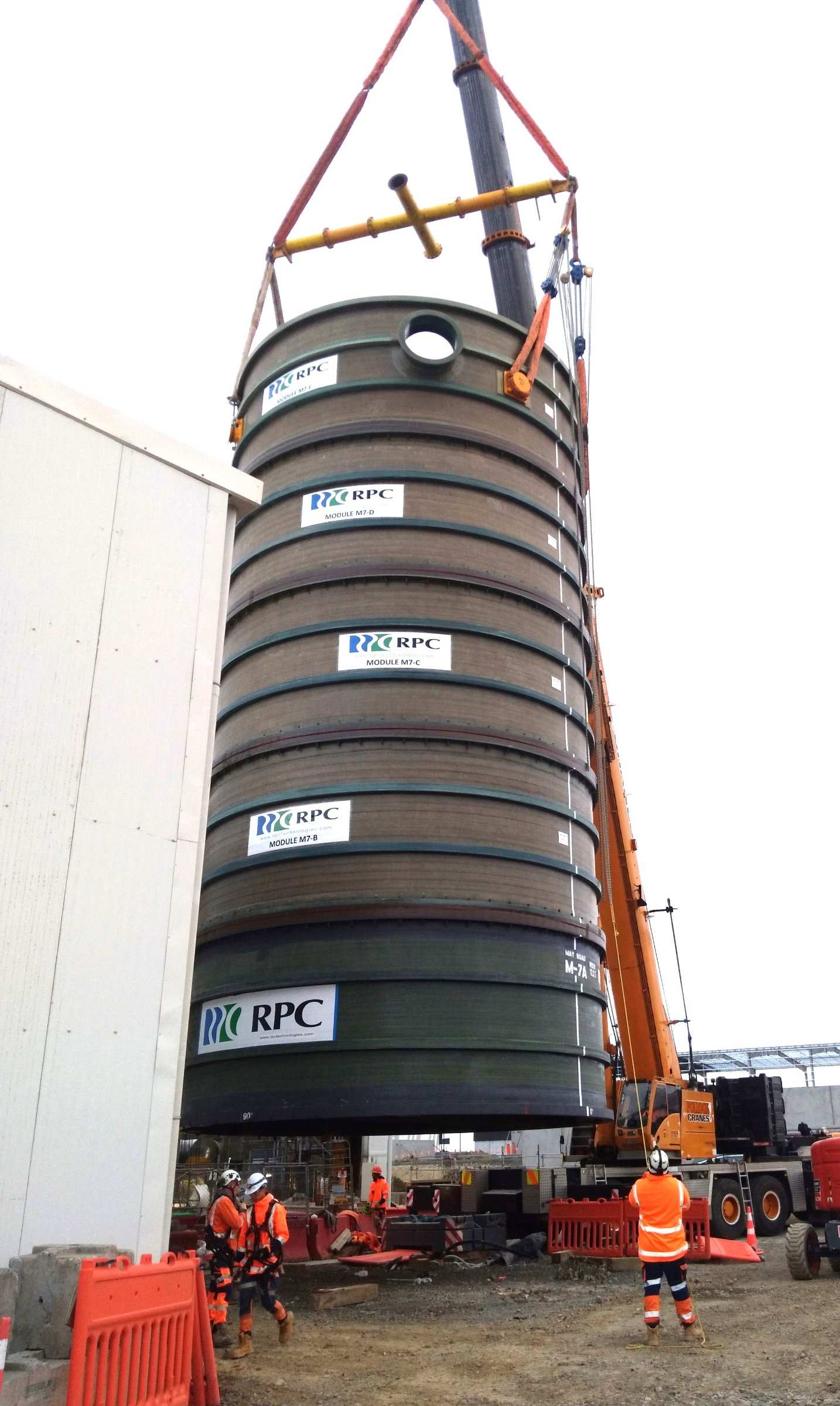
Installation
RPC site teams deliver, assemble and install, from a 67-tonne shaft module placed in a single lift to a 15m dome cover assembled on site.
Inspection
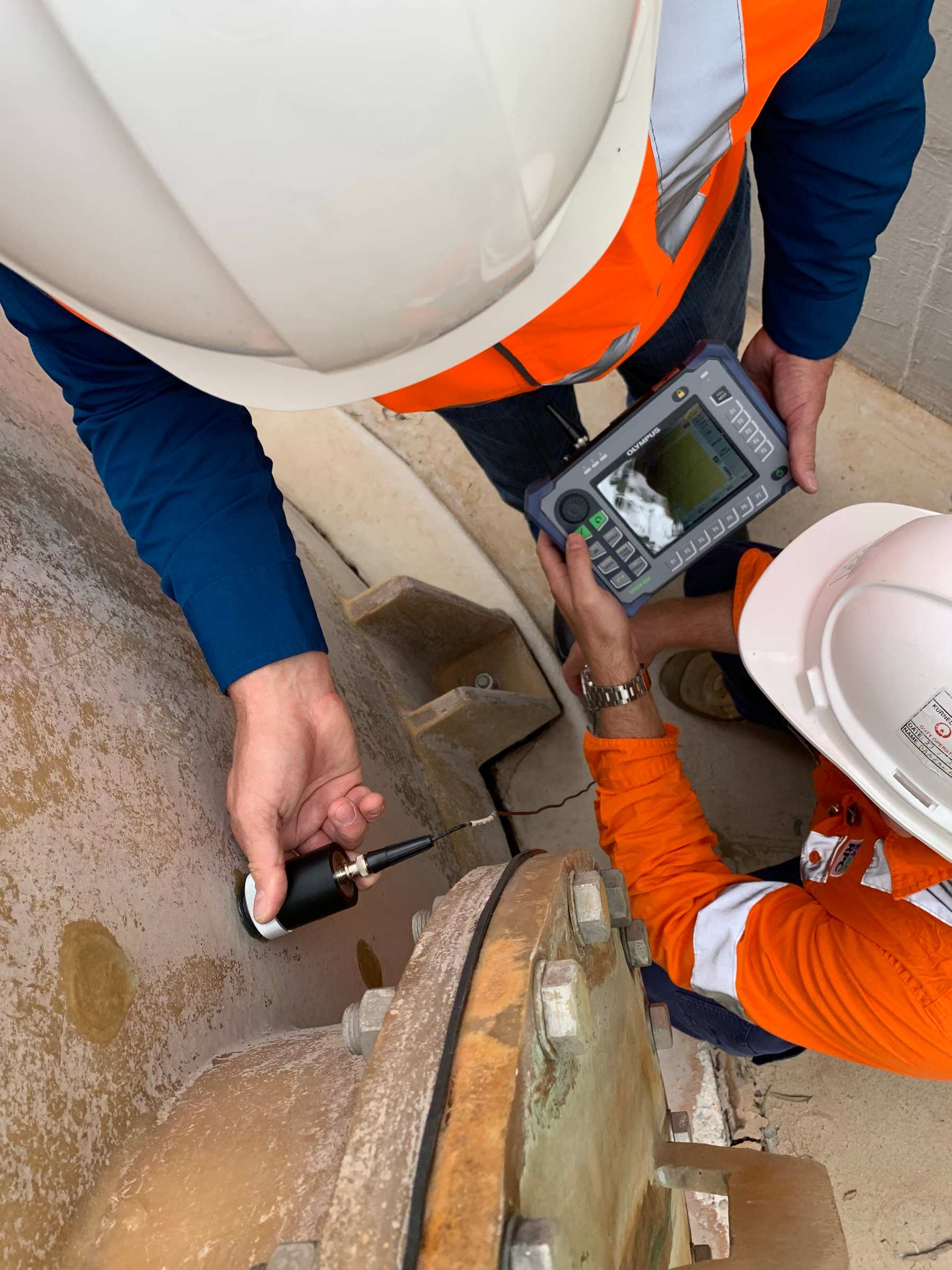
UltraAnalytix® in-service testing assesses GRP assets while they keep operating, without costly shutdowns or confined-space inspections.
Maintenance
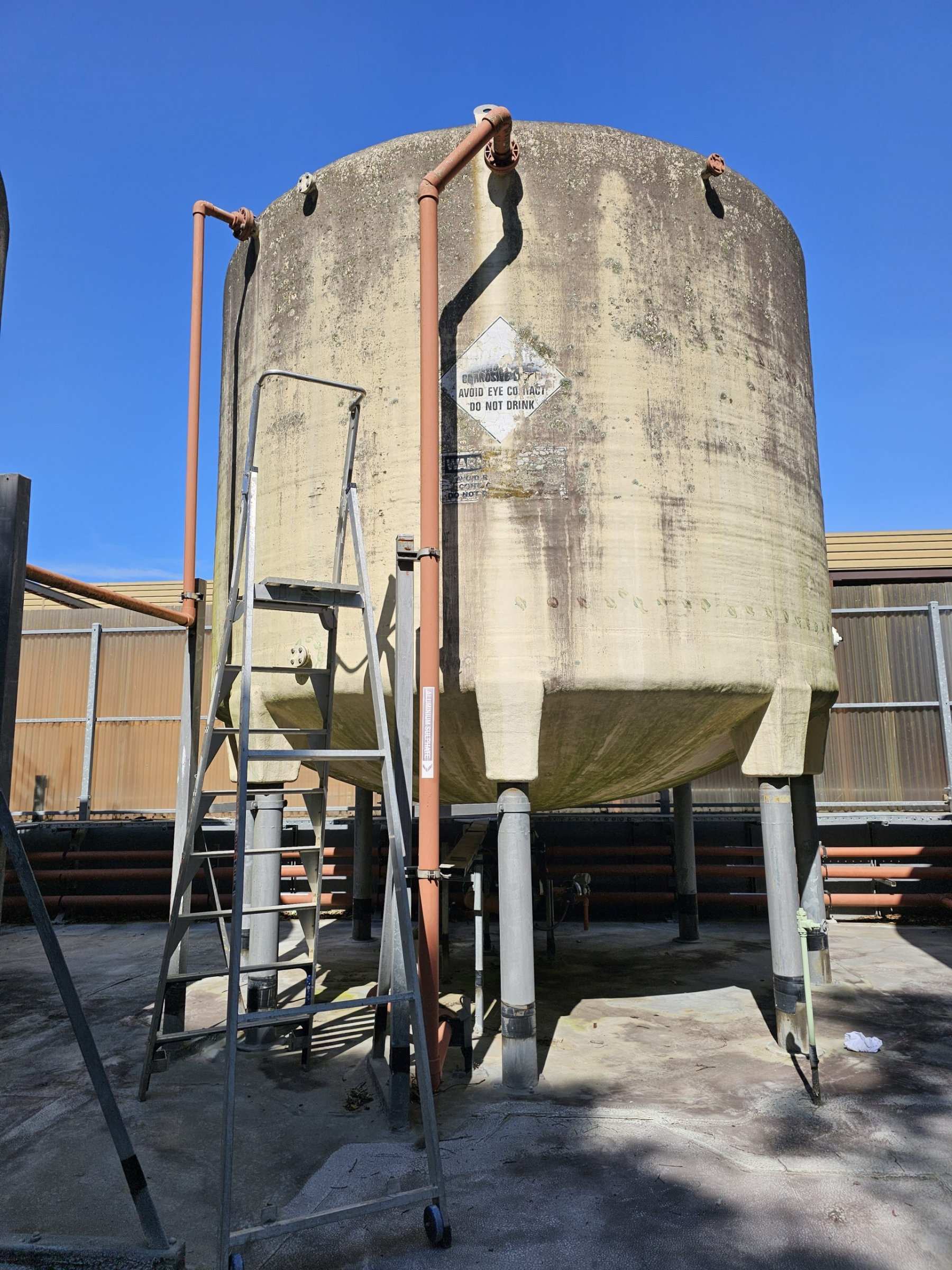
Condition assessment, remaining-service-life reporting and through-life support keep composite assets performing.
Processes
How we make them
RPC specialises in GRP and carbon fibre manufacturing and assembly, with a broad range of in-house processes.
Filament winding
Best for: Pipes, shafts, tanks and other large round structures, including large-diameter pipe up to 3.6–3.9m.
- Corio
- Batam
- Broadmeadow
Resin infusion, VARTM & vacuum consolidation
Best for: High-quality, consistent parts such as one-piece train nose cones and cab fronts.
- Corio
- Broadmeadow
Hand lamination & open moulding
Best for: Bespoke and one-off parts, large covers and test models.
- Corio
- Broadmeadow
- Batam
Prepreg moulding
Best for: High-performance parts, including Defence components using polyester resin prepreg fabrics.
- Broadmeadow
Tooling, patterns & CNC
Best for: Plugs, moulds and CNC-profiled tooling for marine, transport and industrial parts.
- Broadmeadow
- Batam
- Seven Hills
Finishing, assembly & electrical
Best for: Painting and coating, trimming, bonding, seat and module assembly, electrical harnessing and clean-room assembly cells.
- Corio
- Broadmeadow
Testing & quality
Best for: Test laboratory, hydrostatic, vacuum and conductivity testing, EN45545 fire testing and first-article inspection, under ISO 9001.
- Broadmeadow (test lab)
- All plants
3D scanning & printing
Best for: Metrology-grade laser scanning (0.030mm), reverse engineering and rapid prototypes.
- Batam
- Broadmeadow
Metal fabrication (complement)
Best for: Specialty metals for hybrid assemblies and Defence.
- Seven Hills
Facilities
Our facilities
27,000 m² of production area across five manufacturing facilities, working as OneRPC.
Seven HillsSydney, NSW, Australia
- General machining (lathe, mill, drill)
- General and specialist fabrication
- Welding of carbon, high and low alloy steels, stainless steels and aluminium
- Garnet blasting and spray painting
- Refurbishment of Defence and in-house assets
BroadmeadowNewcastle, NSW, Australia
- Mock-up design and production
- Composite prototyping and production
- Lighting system assembly
- Modesty panel and toilet module assembly
- Seat and luggage rack assembly
- Tool and pattern making
- Filament winding
- Test laboratory
- Infusion and vacuum consolidation
- Prepreg moulding
- Hand lamination
- CNC machining
CorioGeelong, VIC, Australia
- Filament winding: 12m horizontal winder, 6m horizontal winder, 3.1m horizontal/vertical winder
- Hand lamination
- Overhead cranage
- Full extraction systems
- Specialist infusion room
- Paint booth
- Post-curing oven
- 24-hour operation
- Seat assembly
BatamBatam Island, Indonesia
- Four 4m (diameter) × 12m (length) filament winders
- Pipe produced up to 3.9m in diameter
- Post-curing ovens, rotators and pipe end preparation
- CNC-cut tooling
- Portable 3D laser scanning
CoimbatoreTamil Nadu, India
Rail and mobility composites (front ends).
Coimbatore on LocationsNot familiar with composite solutions compared to steel or concrete? Talk to the experts.
Tell us about your project and we’ll connect you with the right sector team.